
Short answer: every emergency light and illuminated exit sign in a commercial building has to be tested twice — a 30-second function test every month, and a 90-minute full-duration test once a year — and you have to keep a written record of both. Those are the emergency light testing requirements in NFPA 101, the Life Safety Code, and they are what the fire marshal in Fairfax County, Arlington, Alexandria, Montgomery County or DC will ask you to show during an inspection.
Most buildings we walk into are doing neither. The units were installed, they have a little green LED, and nobody has pressed the test button since. This article explains what the code actually says, why the annual test is the one that catches real problems, and what a passing record looks like.
Emergency light testing requirements in NFPA 101
NFPA 101 section 7.9 covers emergency lighting and section 7.10 covers exit signs. The testing rules are the same for both:
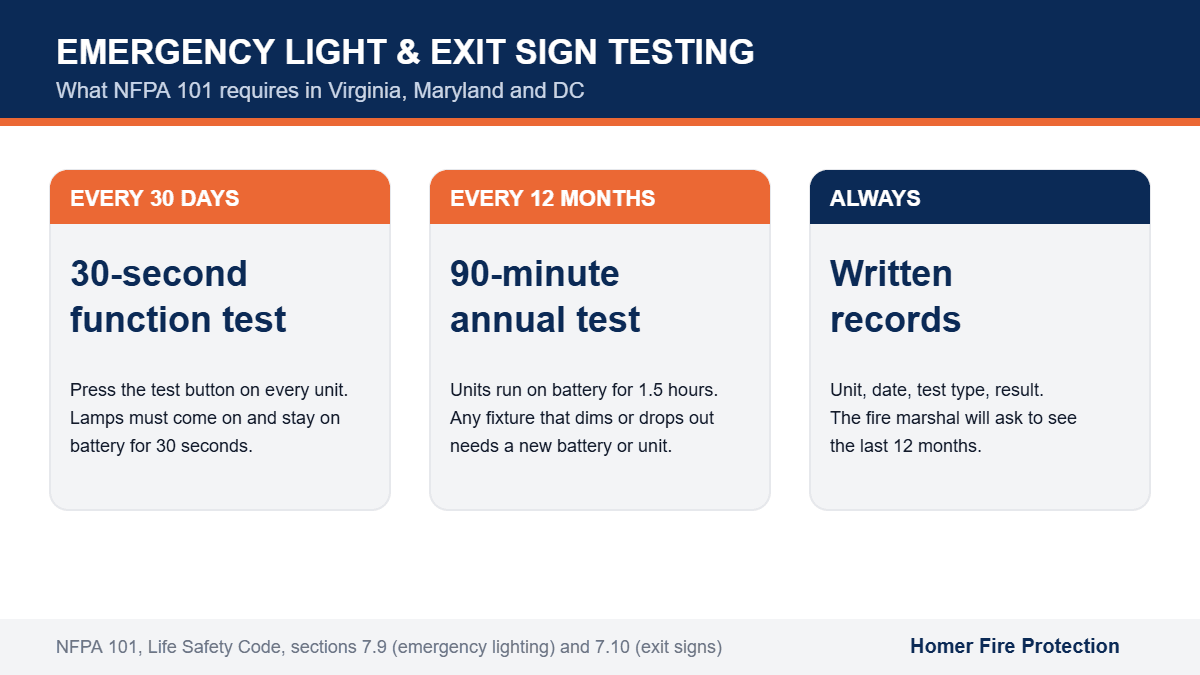
- Monthly functional test — 30 seconds. At intervals not exceeding 30 days, every battery-powered unit is switched to battery (the test button on the housing) and must light for at least 30 seconds. You are confirming the transfer works and the lamps come on.
- Annual full-duration test — 90 minutes. Once a year, each unit is run on battery for 1.5 hours and must stay lit for the whole period. This is the test that proves the battery can carry the load an occupant would need to get out of the building.
- Written records. Both tests are logged with the unit, the date, the type of test and the result, and the log is kept where the authority having jurisdiction can see it. Inspectors in our area routinely ask for the last twelve months.
Virginia, Maryland and the District all enforce fire codes built on the International Fire Code, and all three point back to NFPA 101 for emergency lighting and exit sign maintenance, so the 30-second / 90-minute regime applies across the DMV regardless of which county you are in.
Why the 90-minute emergency light test is the one that fails
A unit will often pass the 30-second test for years after it would fail a 90-minute one. The reason is the battery. Sealed lead-acid and NiCd packs lose capacity as they age; a four-year-old pack can light the lamps for a minute and go dark in ten. The short test confirms the circuit works. Only the long test confirms the capacity is still there.
In our annual inspections across Northern Virginia, the fixtures that fail the full-duration test are almost always one of three things: a battery past its service life (typically three to five years), a lamp or LED board that draws more than the battery can supply, or a charger that stopped charging months ago while the green indicator kept glowing. None of those show up unless someone runs the clock.
Self-testing units: what you still have to do
Many newer fixtures have a self-diagnostic circuit that runs its own 30-second test every month and its own 90-minute test every year, then shows a fault with a flashing LED. NFPA 101 allows the monthly manual test to be replaced by a monthly visual check of that indicator on self-testing units, and it allows computer-based systems to satisfy the monthly requirement with a reviewed report.
Two parts of the emergency light testing requirements do not go away. Someone still has to look at every indicator every month and write down what they saw, and the annual 90-minute test still has to be confirmed and recorded. “The light is green” is not a record.
What a monthly check should cover
If you are doing the monthly test in-house, this is the walk-through our technicians use:
- Press and hold the test button on every emergency light and exit sign for 30 seconds. Both heads must come on and stay on.
- Confirm the charging indicator is lit when the button is released. No indicator usually means no power to the unit.
- Check that exit signs are fully legible — no dark letters, no cracked or yellowed faces.
- Make sure nothing has been stored or mounted in front of a unit or a sign since last month.
- Note the date, the location of each unit, pass or fail, and who did the check.
A unit that fails any of these needs a battery, a lamp or a replacement fixture, and the repair itself gets logged.
What the fire marshal actually looks at
Inspectors in Fairfax, Arlington, Alexandria, Montgomery County and DC generally do three things: press a few test buttons themselves, look for fixtures that are missing or blocked, and ask for the test log. A building with a complete twelve-month log and a dated annual 90-minute test report is usually through that part of the inspection in minutes. A building with no log gets a correction notice and a re-inspection, whether or not the lights happen to work that day.
How Homer Fire handles emergency light testing
Our emergency and exit light service runs the annual 90-minute test on every unit, replaces batteries and lamps on the spot, and leaves you with a fixture-by-fixture report that satisfies the record-keeping side of the emergency light testing requirements. We service offices, retail, restaurants, warehouses and multifamily buildings in Springfield, Fairfax, Arlington, Alexandria, Falls Church, Washington DC and Bethesda, usually on the same visit as your annual extinguisher inspection so you have one date and one report.
If a light in your building has not been tested for 90 minutes in the last year, request a quote or call 703-646-8290 and we will schedule it the same week.
Frequently asked questions
How often do emergency lights need to be tested?
The emergency light testing requirements are monthly for 30 seconds and annually for 90 minutes, per NFPA 101 sections 7.9 and 7.10. Both tests must be recorded.
Do exit signs need the same testing as emergency lights?
Yes. Illuminated exit signs with battery backup follow the same 30-second monthly and 90-minute annual schedule under NFPA 101 section 7.10.
Can I do the emergency light test myself?
The monthly 30-second test can be done by building staff as long as it is recorded. The annual 90-minute test can also be done in-house, but most owners have a fire protection contractor run it because it takes a technician on site for the full duration and failed units need parts the same day.
How long should I keep emergency lighting test records?
NFPA 101 requires written records be kept for the authority having jurisdiction. Keep at least the most recent twelve months of monthly tests and the last annual test report on site; inspectors in the DMV commonly ask for a year.