
Every October, the National Fire Protection Association picks one message for Fire Prevention Week. For 2026 (October 4–10) that message is “Charge into Fire Safety: Safe Charging Is a Superpower” — and it’s aimed at the lithium-ion batteries in the phones, laptops, power tools, e-bikes and scooters we charge every day.
NFPA talks mostly about homes. We want to talk about your business — because the same batteries are charging right now in restaurant back rooms, apartment lobbies, contractor vans, salons, offices and warehouses across the DMV, and almost nobody has a plan for them.
Why this matters more for businesses than for homes
A home has one or two e-bikes. A restaurant with delivery drivers might have six charging by the back door at the end of a shift. A property manager might have dozens in a bike room. A contractor keeps a shelf of power-tool packs on a trickle charge overnight in an empty shop.
Three things make that different from a home:
- Density. More batteries in one place means one failure can involve many packs.
- Unattended charging. Overnight charging in an empty building is the worst-case scenario — no one is there to notice the smell, the swelling or the smoke.
- Exit paths. Back rooms and lobbies are also exit routes. A battery fire near your only way out is a life-safety problem, not a property problem.
The risk is not theoretical for our region. Local fire departments reported 17 lithium-ion battery fires in Fairfax County and 8 in Washington, DC in 2023 alone, and incidents have continued — including a 2025 fire involving Capital Bikeshare batteries at a DC warehouse and multiple e-bike battery fires that displaced DC families. Nationally, a single e-bike battery model was linked to 31 fires and roughly $734,500 in property damage before the Consumer Product Safety Commission told owners to stop using it.
What actually happens in a lithium-ion battery fire
This is the part most people get wrong, so it’s worth two minutes.
A damaged, overcharged or defective lithium-ion cell can go into thermal runaway — a chain reaction where the cell heats itself, releases flammable gas, and ignites. Once one cell goes, it heats the cell next to it. The fire makes its own heat and its own fuel.
That has two consequences for how you respond:
- You can’t smother it. Removing oxygen — which is how most extinguishers work — does not stop a battery that is generating its own reaction. The only thing that reliably stops thermal runaway is cooling, and the best cooling agent available in most buildings is plain water, in large quantities.
- It comes back. A battery fire that looks out can reignite minutes or hours later as neighboring cells reach temperature. Never assume it’s over.
Which fire extinguisher works on a lithium-ion battery fire?
We sell and service extinguishers, so we’ll be straight with you about their limits.
A standard ABC dry-chemical extinguisher will not stop a lithium-ion battery in thermal runaway. What it will do — and this is important — is knock down the flames on everything the battery has set alight around it: the cardboard box, the bench, the jacket hanging on the hook. That buys time and stops the fire spreading while people get out. That’s a real job, and every business should have a properly inspected ABC extinguisher within reach of any charging area.
Do not reach for a Class D extinguisher. Class D is for combustible metal fires (magnesium, titanium, sodium). Consumer lithium-ion batteries contain no lithium metal, and Class D powders can conduct electricity. It’s the wrong tool.
Water is your friend for small devices. A phone, laptop or hand-tool battery that is smoking or venting can be doused with water or, if it’s safe to do so, moved outdoors onto concrete with a non-flammable tool. For anything e-bike-sized or larger, or if the fire is already established: evacuate and call 911. Firefighters will cool it with far more water than any extinguisher carries, and they will stay to make sure it doesn’t reignite.
There are newer agents marketed specifically for lithium-ion fires. Some have merit for particular settings — we’re happy to discuss them for a bike room or a battery storage cabinet — but none of them replaces the three basics above: distance, water and getting out.
The Safe Charging rules for your workplace
Adapted from NFPA’s charging guidance, with the commercial reality added.
Charging
- Use only the charger that came with the device, or one the manufacturer approves. Mismatched chargers are a leading cause of failures.
- One charger per outlet. No power strips, no daisy-chained extension cords for battery charging.
- Charge on a non-combustible surface — concrete floor, metal shelf, metal bench. Not wood, not cardboard, not on top of the recycling.
- Don’t charge overnight in an empty building if you can avoid it. If you can’t, put the charging area somewhere with a smoke detector and nothing flammable nearby, and consider a timer that cuts power when charging should be complete.
- Bring cold or wet devices indoors and let them reach room temperature before charging.
Storage
- Keep charging and storage away from exits. Never in a hallway, stairwell or the only path to a door.
- Keep batteries out of direct sun, off heaters and away from anything that burns.
- Limit how many batteries you store. If you must hold spares, keep them at partial charge in a fire-resistant cabinet.
Buying
- Only buy devices and replacement batteries that carry a recognized safety certification mark (such as UL). Uncertified batteries sold online are the single biggest driver of the fires making the news.
- Never buy or accept a battery that has been repaired, rebuilt or opened.
Watching
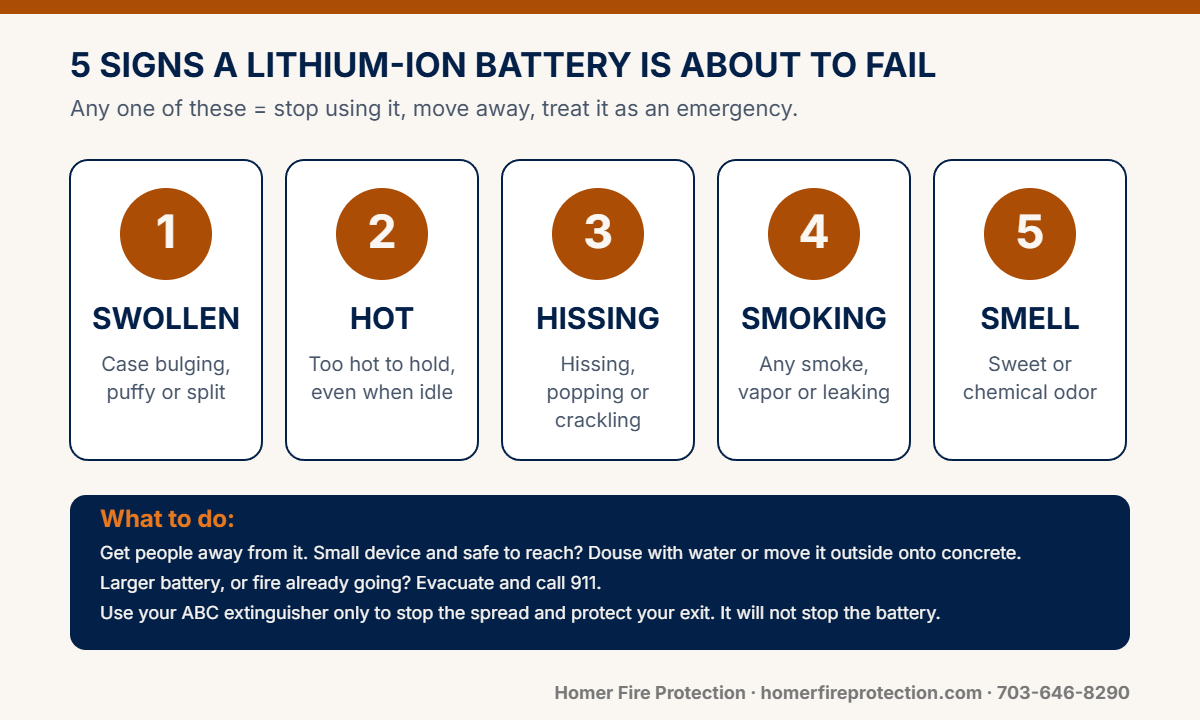
- Stop using — and get away from — any battery that is swollen, hot, hissing, smoking, leaking or smells sweet or chemical. Treat it as an emergency, not a nuisance.
- Don’t throw damaged batteries in the trash or recycling. They cause fires in trucks and transfer stations. Use a battery drop-off point.
A five-minute walk-through you can do this week
Grab a coworker and walk the building with this list:
- Where are batteries charged? Is anything flammable within an arm’s reach?
- Is any charging area on or next to an exit route?
- Is every charger the correct one for its device?
- Is there a working, tagged ABC extinguisher within 75 feet of the charging area, and does the person who works there know where it is?
- Is there a smoke detector covering the area — especially if charging happens after hours?
- Does anyone on the team know what a failing battery looks and smells like, and what to do?
If the answer to number 6 is “not really,” that’s the one to fix first. It’s the cheapest, and it’s the one that saves lives.
What Homer Fire Protection can do
We’re a local commercial fire protection company based in Alexandria. During and after Fire Prevention Week we can:
- Inspect and tag your extinguishers and make sure the right units are positioned near charging areas — request a quote or call 703-646-8290.
- Train your team on extinguisher use and fire response with our online Fire Extinguisher Safety Awareness course, completed on their phone in under an hour, with a certificate for your compliance file.
- Look at the whole picture — kitchen suppression, exit and emergency lighting, and extinguisher coverage — in one visit, so a charging-area risk doesn’t get handled in isolation.
Frequently asked questions
Can I put out a lithium-ion battery fire with a regular ABC extinguisher?
Not the battery itself. An ABC extinguisher will stop the fire spreading to surrounding materials, which is worth doing if it’s safe. But a battery in thermal runaway makes its own heat and fuel, so it keeps going until it is cooled — usually with large amounts of water by the fire department. Use the extinguisher to protect your exit, then leave and call 911.
Should I buy a Class D extinguisher for e-bike batteries?
No. Class D extinguishers are for combustible-metal fires such as magnesium. Consumer lithium-ion batteries contain no lithium metal, and Class D agents can conduct electricity. Keep a properly rated ABC extinguisher nearby and rely on water and evacuation for the battery itself.
Is it safe to charge e-bikes or scooters inside my restaurant or building?
It can be, with rules: manufacturer chargers only, one per outlet, on a concrete or metal surface, away from exits and combustibles, with a smoke detector covering the area, and ideally not unattended overnight. Many businesses set up a dedicated charging corner and put the rules on the wall.
What are the warning signs a battery is about to fail?
Swelling, unusual heat, a hissing or popping sound, smoke, leaking, or a sweet or chemical smell. Any of these means stop using it, move it away from people and combustibles if you safely can, and treat it as an emergency.
What is the theme of Fire Prevention Week 2026?
NFPA’s 2026 theme, for October 4–10, is “Charge into Fire Safety: Safe Charging Is a Superpower.” It focuses on safe charging, storage and use of lithium-ion-powered devices such as phones, laptops, power tools, e-bikes and scooters.
How do I dispose of a damaged lithium-ion battery?
Never in household trash or recycling — they cause fires in collection trucks and facilities. Use a certified battery drop-off (many hardware stores and county hazardous-waste sites accept them). If the battery is damaged or swollen, ask the drop-off site how they want it handled before you bring it in.
Sources used for facts in this guide: NFPA Fire Prevention Week 2026 announcement and lithium-ion safety tip sheet; OSHA lithium-ion battery safety bulletin; NBC4 Washington and WUSA9 reporting on DMV incidents; CPSC warning on Rad Power Bikes batteries. Homer Fire Protection is a fire protection contractor, not a fire department; in an emergency, always call 911.